MON, OCT 27, 2025
In The Order of Things, Michel Foucault explores how systems of knowledge are constructed through invisible rules of classification.
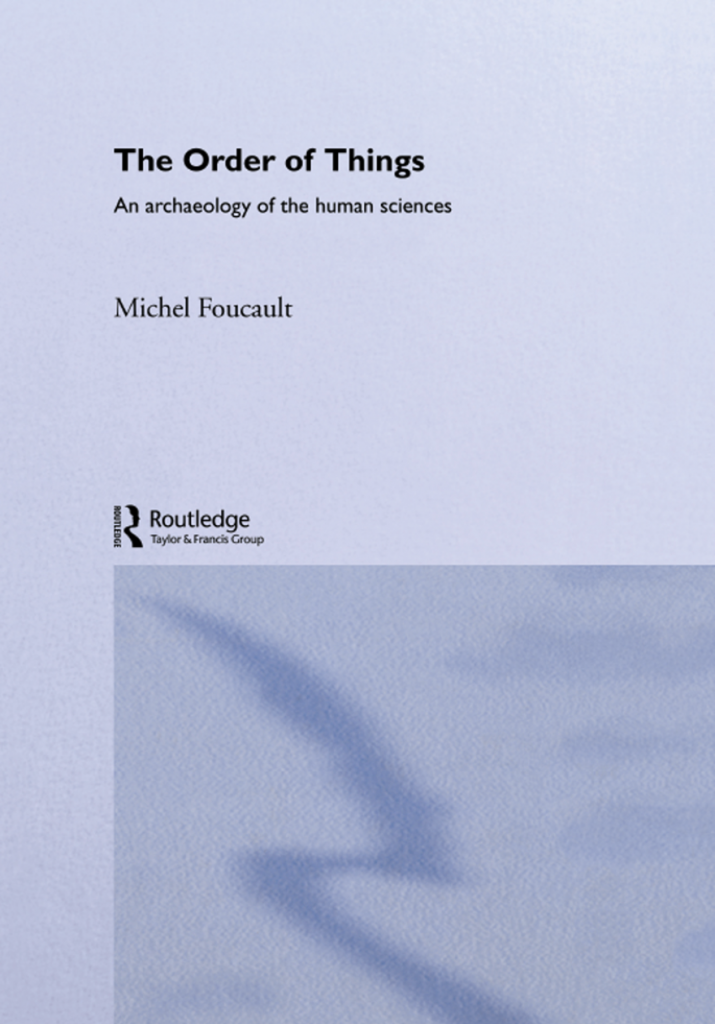
He argues that what we consider as “truth” or “order” is never neutral — it is produced by the ways we categorise and name things.
In this sense, Foucault’s writing can itself be read as a catalogue of systems, an archive of how human thought organises the world.
Applying the method of cataloguing, I approached the text as a structured collection rather than a linear argument.
I designed an inventory that breaks the text into three main elements:
1️⃣ Words that describe order and system (e.g., “classification”, “arrangement”, “taxonomy”),
2️⃣ Words that indicate power and control (e.g., “knowledge”, “discourse”, “limit”), and
3️⃣ Words that reveal instability (e.g., “difference”, “gap”, “ambiguity”).
This inventory shows how Foucault’s language itself performs the logic he describes — constructing systems while simultaneously exposing their fragility.
The repetition of these terms forms a rhythm, a pulse of philosophical “cataloguing” that both builds and questions structure.
As metadata, I also noted the text’s tone and structure:
Foucault writes in long, looping sentences that create a feeling of accumulation — like an ever-expanding archive.
His rhetorical rhythm mimics the very act of cataloguing: assembling fragments, linking them, and challenging their hierarchy.
By cataloguing Foucault’s language, I realised that his work is not only about systems of knowledge, but also a reflection on how we store and classify meaning itself.
In my own project, I translated this into the cataloguing of physical traces — folds, stains, and marks — to reveal how human presence constructs another kind of order, one made of memory and time rather than logic and language.
Thus, both Foucault’s text and my visual catalogue investigate how order emerges from chaos,
and how every system, whether linguistic or material, always contains the possibility of disorder within it.
References
Foucault, M. (1989) The Order of Things: An Archaeology of the Human Sciences. London: Routledge.
(Originally published in French, 1966)
Anderson, B. (2006) Census, Map, Museum: Imagined Communities. London: Verso.
Derrida, J. and Prenowitz, E. (1995) ‘Archive Fever: A Freudian Impression’, Diacritics Journal, 25(2), pp. 9–63.
Mattern, S. (2014) ‘Library as Infrastructure’, Places Journal, June.
Available at: https://placesjournal.org/article/library-as-infrastructure/ (Accessed: 27 October 2025).
Borges, J.L. (1998) Collected Fictions. London: Penguin Classics.
Comments